
Free Spin vs. Real Performance: Why Modern Dog Treadmills Are About Much More Than Rotations
If you’ve been around mechanical dog treadmills for a while, you’ve probably seen videos where someone spins the running belt by hand and counts how many rotations it makes before stopping.
For years, this became one of the most common ways to compare slatmills.
But is it still the best way to judge a modern dog treadmill?
The short answer is no.
Where Did the “Free Spin” Test Come From?
The free-spin comparison dates back to the early days of slatmills, when they were used almost exclusively by American Pit Bull Terriers for carpet mill and treadmill racing.
At that time, the primary objective was simple:
- achieve the lowest possible rolling resistance
- maximize acceleration
- maximize top speed
Back then, the number of free rotations was considered an important indicator of performance because racing was the main purpose of the equipment.
The Industry Has Changed
Over the last 10–15 years, mechanical dog treadmills have evolved dramatically.
Today, they are no longer used only for racing. They are trusted by:
- professional dog trainers
- veterinarians
- canine rehabilitation specialists
- police and military K9 units
- sport dog handlers
- fitness professionals
- everyday owners who simply want to keep their dogs active
As the users changed, so did the engineering priorities.
A Great Treadmill Is a Balance of Many Factors
At Firepaw, reducing rolling resistance is still important—but it is only one element of a much larger engineering equation.
Modern professional treadmills must also provide:
- excellent joint protection
- long-term durability
- structural stability
- low vibration
- reduced noise
- smooth and predictable operation
- reliability after thousands of kilometers of use
Optimizing one characteristic often affects another.
For example, making a running belt slightly stronger and more durable can increase rolling resistance by a small amount while dramatically improving longevity and stability.
From an engineering perspective, that is often the better decision.
Why Firepaw Changed
As Firepaw evolved, so did our philosophy.
Earlier generations were designed with a greater emphasis on achieving extremely low rolling resistance.
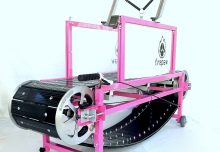
Today’s Phoenix generation has been refined with a broader goal: creating one of the most balanced professional dog treadmills available.
We’ve introduced improvements such as:
- a slightly wider and denser running belt for improved durability
- advanced joint protection systems
- vibration reduction
- stronger structural components
- quieter operation
- improved long-term reliability
These improvements create a treadmill that performs exceptionally well over many years—not just during a free-spin demonstration.
Free Spin Isn’t Always Compared Fairly
Another important point is that free-spin videos are rarely standardized.
Results depend on many variables, including:
- treadmill size
- running belt material
- belt width
- wheel diameter
- bearing condition
- whether the treadmill is new or broken in
- how much force is used to start the rotation
Traditionally, these demonstrations are performed on medium-sized treadmills fitted with wooden running belts, which are the lightest configuration.
Even then, many videos show the treadmill being spun using the full force of the entire body—not something a dog ever does during normal exercise.
This makes direct comparisons less meaningful than they may appear.
New Treadmills Need Time
Another point that is often overlooked is that every new mechanical treadmill requires a break-in period.
As the components settle and naturally wear into one another:
- rolling resistance decreases
- movement becomes smoother
- overall efficiency improves
A treadmill that has been used regularly for several weeks will often feel noticeably freer than it did on the first day.
The Real Question
Instead of asking:
“How many rotations does it make?”
A better question today is:
- How well does it protect the dog’s joints?
- How stable is it at high speed?
- How quiet is it?
- How durable will it be after years of daily use?
- How consistent is its performance?
- How comfortable is it for the dog?
Those are the questions professional users ask.
Our Philosophy
At Firepaw, we don’t design treadmills to win free-spin competitions.
We design them to perform day after day, year after year.
Our goal is to create equipment that professional trainers, veterinarians, rehabilitation specialists, working dog handlers, and serious dog owners can trust for thousands of training sessions.
Because in the end, real performance isn’t measured by how long an empty belt spins.
It’s measured by how well the treadmill performs when a dog is actually using it.