
Are Mechanical Dog Treadmills Cruel? What Science Really Says About Canine Fitness and Safety
Understanding the science behind dog treadmills, voluntary exercise, joint protection, and why professionals worldwide use them.
Some people see a dog running on a treadmill and immediately question whether it is natural, necessary, or even humane.
“Why not just walk your dog?”
“Isn’t this forcing the animal to exercise?”
“Surely a treadmill cannot replace a proper walk?”
These are reasonable questions when asked out of genuine concern for animal welfare. Unfortunately, they are also common misconceptions surrounding mechanical dog treadmills, often called slatmills.
The reality is that treadmill exercise is an established subject of veterinary research, canine rehabilitation, and working-dog conditioning.
At Firepaw, we believe the discussion should be based on scientific evidence, responsible training practices, and animal welfare — rather than assumptions.
Let’s look at what the research actually tells us.
1. Dog Treadmills Are Used in Veterinary Science — Not Just Dog Gyms
One of the strongest arguments supporting the legitimate use of dog treadmills is their role in veterinary research and professional canine conditioning.
Researchers at the University of Pennsylvania’s Penn Vet Working Dog Center published a study in 2022 titled A Formalized Method to Acclimate Dogs to Voluntary Treadmill Locomotion at Various Speeds and Inclines.
The study examined how working dogs could be gradually introduced to treadmill exercise through structured, voluntary training.
The researchers described the treadmill as:
“a multipurpose tool with a unique set of behavioral and physical benefits”
Seven of eight previously inexperienced dogs successfully completed the acclimation protocol.
The important point is not simply that dogs can learn to use treadmills. It is that researchers specifically investigated voluntary participation, low-stress introduction, and safe exercise progression.
This is a very different picture from the idea that treadmill training must involve forcing an unwilling animal to run.
Scientific reference: Stigall et al., 2022, Animals. [1]
2. Mechanical Treadmills Give Dogs Control Over Their Movement
One of the most important differences between mechanical and motorized treadmills is how the running surface moves.
On a conventional electric treadmill, a motor determines the belt speed.
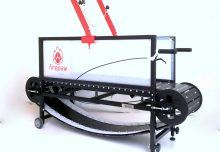
On a mechanical slatmill such as the Firepaw Phoenix, the running belt is powered by the dog’s own movement.
The dog can accelerate, slow down, walk, trot, or stop driving the belt.
This provides an important level of control over exercise intensity.
However, dog-powered operation does not automatically guarantee safety. Correct introduction, suitable equipment, appropriate restraint, continuous supervision, and the dog’s willingness to participate remain essential.
A properly trained dog should be comfortable approaching the treadmill, entering it, exercising, and finishing the session without fear or coercion.
This approach is consistent with the voluntary acclimation principles described by researchers at the Penn Vet Working Dog Center. [1]
The objective should never be to force a dog to exercise.
It should be to create an environment where exercise becomes a positive and rewarding activity.
3. Canine Exercise Has Measurable Cardiovascular Benefits
Physical conditioning is not simply about making dogs run faster or building visible muscle.
It involves physiological adaptations that can be studied and measured.
A study published in Frontiers in Veterinary Science in 2021 investigated heart-rate responses during treadmill walking in healthy dogs.
Researchers from Michigan State University and their collaborators demonstrated that treadmill exercise produced measurable cardiovascular responses and examined how heart-rate monitoring could help guide exercise protocols.
Their findings support the value of monitoring exercise intensity rather than relying entirely on visual impressions. [2]
Another study, published in the American Journal of Veterinary Research in 2019, investigated exercise intensity in 18 healthy Beagles using treadmill testing.
Researchers evaluated lactate thresholds, glucose responses, and heart-rate measurements to assess exercise capacity.
They concluded that treadmill-based physiological measurements may be useful for designing and evaluating canine conditioning programs. [3]
What does this mean for dog owners?
It means structured treadmill exercise can be much more than an activity to burn energy.
With appropriate training and monitoring, it can support measurable cardiovascular conditioning, endurance development, and physical fitness.
These benefits are particularly relevant for sporting dogs, hunting breeds, working K9s, and highly active family dogs.
4. Is Running on a Treadmill Natural for Dogs?
A common criticism is that treadmill running is unnatural.
But what does the research show?
A 2013 study published in the American Journal of Veterinary Research compared canine movement during treadmill exercise with movement over natural ground.
Researchers from the University of Georgia examined three-dimensional joint movement in five healthy dogs.
They found that treadmill and overground walking and trotting produced broadly similar movement patterns, although some differences were present.
This matters because it demonstrates that treadmill exercise can reproduce important characteristics of normal canine locomotion.
It does not mean treadmill running is biomechanically identical to outdoor running.
The scientific conclusion is more useful: treadmill locomotion can be a legitimate form of canine movement, even though it is not a perfect substitute for every aspect of outdoor exercise. [4]
And that distinction is important.
5. Why Joint Protection Matters — The Firepaw Difference
Not all dog treadmills are engineered to the same standard.
A dog’s joints, tendons, ligaments, and muscles experience repeated mechanical loading during physical activity.
The magnitude and distribution of those loads depend on several factors, including speed, surface characteristics, body weight, gait, and exercise intensity.
This is especially relevant for large breeds, senior dogs, and high-performance working dogs.
At Firepaw, joint protection has been a central part of our engineering philosophy.
Rather than relying solely on the flexibility of the running belt, we have developed a multi-level shock-absorbing system incorporating specially designed vibration-absorbing components.
Our engineering objective is to reduce the transmission of impact and vibration through the treadmill structure while maintaining smooth, stable movement.
The Firepaw Phoenix also incorporates carefully engineered running components, including our proprietary silicone running wheels, designed to improve durability, reduce operating noise, and provide an additional level of vibration absorption.
These are meaningful design considerations, particularly for dogs exercising frequently.
An important scientific distinction: Research supports the importance of canine biomechanics and controlled exercise, but independent comparative studies are still needed to quantify how much Firepaw’s particular joint-protection system reduces forces on canine joints compared with other treadmills or outdoor surfaces.
We believe responsible manufacturers should be transparent about that distinction.
Our approach is simple: engineer equipment with the dog’s long-term comfort and physical well-being in mind.
6. Why Treadmills Can Be Particularly Useful for Large and Senior Dogs
Large dogs and aging dogs often require carefully managed exercise.
Maintaining mobility and muscle condition is important, but excessive intensity, inappropriate surfaces, or sudden changes in activity can create unnecessary risks.
A properly selected treadmill can offer a predictable exercise environment where the handler controls session duration and supervises the dog’s movement.
Firepaw’s joint-protection technology is designed with these considerations in mind.
For older dogs, the goal is not maximum speed or intense conditioning.
It may simply be maintaining comfortable movement and an appropriate level of physical activity.
For large breeds, stability, sufficient running space, and properly designed equipment become especially important.
Treadmill exercise may also be incorporated into rehabilitation programs when recommended by a veterinarian or qualified canine rehabilitation professional.
Dogs recovering from surgery, experiencing pain, or living with orthopedic conditions require individual assessment. A mechanical treadmill is not automatically appropriate for every rehabilitation case.
The purpose is controlled, appropriate movement — never exercise at the expense of the dog’s comfort.
7. Why Professional Trainers, Working-Dog Units, and Universities Use Treadmills
Professional canine conditioning requires consistency.
Military and police dogs, sporting dogs, detection dogs, and professional canine athletes often need carefully structured physical preparation.
Outdoor exercise remains essential, but it is not always possible to achieve the same training conditions consistently.
Weather, temperature, terrain, available space, and working schedules can all influence training.
A treadmill provides a practical environment for structured exercise, allowing trainers to focus on particular conditioning objectives.
Scientific research also demonstrates the relevance of treadmills for assessing working-dog fitness.
The Penn Vet Working Dog Center study specifically investigated treadmill acclimation in working dogs and dogs involved in detection research. [1]
Firepaw equipment is used by professional dog trainers, canine fitness businesses, rehabilitation facilities, universities, and military and police organizations, including NATO-associated forces.
These professional applications demonstrate that mechanical dog treadmills have a serious role beyond recreational exercise.
They are tools for people who take canine fitness, preparation, and performance seriously.
8. Phoenix and Dragon: Different Training Goals, Different Benefits
Not every dog requires the same type of exercise.
That is why Firepaw develops different mechanical treadmill systems.
Firepaw Phoenix — Speed, Endurance, and Cardiovascular Conditioning
The Firepaw Phoenix Slatmill is designed for smooth, dog-powered movement with relatively low running resistance.
It is particularly suited to:
- Cardiovascular conditioning and stamina
- Controlled walking and jogging
- Speed and athletic conditioning
- Structured fitness programs for active dogs
Its advanced joint-protection system and dog-controlled operation make it a versatile training platform for professional facilities and individual owners.
Firepaw Dragon — Strength, Resistance, and Power
The Firepaw Dragon High-Resistance Treadmill takes a different approach.
Its running system is designed to provide substantially greater resistance, making it suitable for shorter, strength-oriented conditioning sessions.
The Dragon focuses on muscular effort, controlled resistance, and power development.
The latest generation also incorporates Firepaw’s shock-absorbing technology.
Neither model should be used to push a dog beyond its physical capabilities. Higher-resistance exercise requires particular attention to conditioning level, fatigue, and recovery.
Phoenix develops the foundations of speed and endurance. Dragon introduces a different resistance-based training stimulus.
Together, they offer professional trainers greater flexibility in designing appropriate canine fitness programs.
9. Can Treadmill Exercise Replace Walking Your Dog?
No — and it should not have to.
Outdoor walks provide experiences that a treadmill cannot fully reproduce.
Dogs need opportunities to explore, smell, interact with their surroundings, and experience different environments.
These activities are important parts of canine welfare.
But the argument that a dog should only exercise outdoors creates a false choice.
A treadmill is not intended to eliminate outdoor walks.
It is an additional tool.
Consider a professional working dog that already receives daily outdoor exercise but requires structured cardiovascular conditioning.
Or a high-energy dog living in a region with long winters and limited opportunities for consistent exercise.
Or a dog attending a professional canine fitness facility for supervised conditioning.
In these situations, treadmill exercise can complement an already active and fulfilling lifestyle.
Walking and treadmill training are not competitors. They serve different, often complementary purposes.
10. What About Animal Welfare? Can a Slatmill Be Abused?
Of course.
Any exercise equipment can be misused.
Excessive training, inappropriate restraint, ignoring signs of fatigue, or forcing an unwilling dog to participate can compromise animal welfare.
The same is true of excessive running, cycling with dogs, weight-pulling activities, or other demanding forms of exercise.
The equipment alone does not determine whether an activity is humane.
The way it is used matters.
Responsible treadmill training should always include:
- Voluntary, positive introduction and gradual progression
- Appropriate exercise intensity for the dog’s age, health, and conditioning
- Continuous supervision and safe equipment setup
- Adequate hydration, rest, and recovery
- Immediate termination of exercise if the dog shows distress, pain, overheating, or abnormal fatigue
A dog should never be left unattended on a treadmill or forced to continue exercising through fear, restraint, or exhaustion.
The Penn Vet research reinforces the importance of acclimation and voluntary treadmill participation. [1]
Responsible use is what separates a valuable training tool from an inappropriate training practice.
11. The Real Question Isn’t Whether Dogs Should Use Treadmills
The real question is whether a particular exercise method improves the dog’s quality of life when used responsibly.
Scientific research has demonstrated that treadmill exercise can be used to study canine locomotion, cardiovascular responses, exercise capacity, and structured training.
It has also shown that dogs can learn to participate voluntarily through appropriate acclimation.
These findings do not mean every treadmill is equally safe or that every dog should use one.
They do, however, challenge the claim that treadmill exercise is inherently cruel, unnatural, or without legitimate benefits.
At Firepaw, we have spent more than a decade developing mechanical treadmills specifically for dogs.
Our focus has always been on engineering, durability, controlled movement, and joint protection.
We believe dogs deserve thoughtfully designed exercise equipment, just as they deserve responsible training and appropriate veterinary care.
And we believe conversations about canine welfare should be informed by evidence rather than prejudice.
Final Thoughts: Better Informed. Better Trained. Healthier Dogs.
A dog treadmill is not a replacement for affection, outdoor adventures, social interaction, or responsible ownership.
It is another way to support physical activity.
For some dogs, it offers structured athletic conditioning. For others, it provides an additional opportunity to stay active when outdoor conditions are unsuitable.
For professionals, it offers consistency and control.
For owners, it offers flexibility.
And for the dog, when properly introduced and responsibly used, it can be an enjoyable part of a balanced exercise routine.
The goal has never been to replace the natural life of a dog. It is to give dogs more opportunities to live an active, healthy one.
Firepaw — Engineered for Dogs. Trusted by Professionals. Built Around Their Well-Being.
Scientific References
The following peer-reviewed publications support the discussion of canine treadmill exercise, locomotion, conditioning, and voluntary training. They investigate canine exercise and treadmill use generally; they are not independent clinical evaluations of Firepaw products.
[1] Stigall, A. R., Farr, B. D., Ramos, M. T., & Otto, C. M. (2022).
A Formalized Method to Acclimate Dogs to Voluntary Treadmill Locomotion at Various Speeds and Inclines.
Animals, 12(5), 567.
University of Pennsylvania, Penn Vet Working Dog Center.
https://doi.org/10.3390/ani12050567
[2] Shull, S. A., Rich, S. K., Gillette, R. L., & Manfredi, J. M. (2021).
Heart Rate Changes Before, During, and After Treadmill Walking Exercise in Normal Dogs.
Frontiers in Veterinary Science, 8, 641871.
https://doi.org/10.3389/fvets.2021.641871
[3] Restan, A. Z., et al. (2019).
Lactate and Glucose Thresholds and Heart Rate Deflection Points for Beagles During Intense Exercise.
American Journal of Veterinary Research, 80(3), 284–293.
https://doi.org/10.2460/ajvr.80.3.284
[4] Torres, B. T., et al. (2013).
Comparison of Overground and Treadmill-Based Gaits of Dogs.
American Journal of Veterinary Research, 74(4), 535–541.
University of Georgia.
https://doi.org/10.2460/ajvr.74.4.535
[5] Häusler, K. A., et al. (2020).
Evaluation of the Repeatability of Kinetic and Temporospatial Gait Variables Measured with a Pressure-Sensitive Treadmill for Dogs.
American Journal of Veterinary Research, 81(12), 922–929.
https://doi.org/10.2460/ajvr.81.12.922
[6] Miyata, T., Kawai, S., Yasuki, A., & Ishioka, K. (2023).
Changes in Physiological Parameters in Healthy Dogs on an Underwater Treadmill When the Water Level Is Set at the Hip Joint.
Research in Veterinary Science, 161, 20–22.
https://doi.org/10.1016/j.rvsc.2023.05.013
Note: Reference [6] concerns underwater treadmills and supports the broader discussion of controlled canine exercise, not claims about the mechanical performance of land-based slatmills.